GPhC-registered pharmacies · London & Nottingham | Free UK delivery: eligible orders £50+; selected items £60+ | Find your branch




Only 1 left in stock
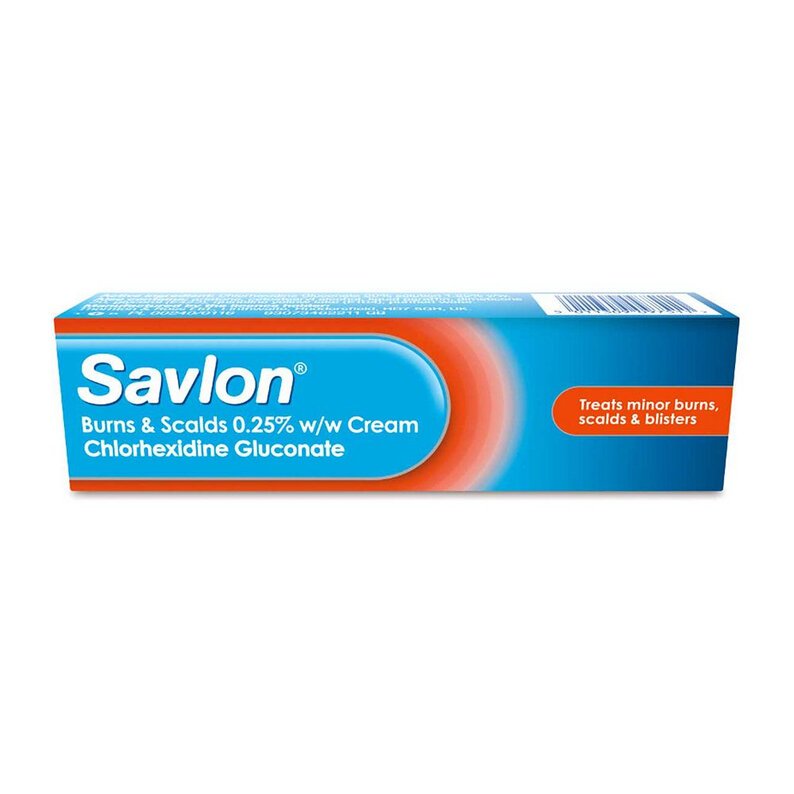
Savlon Burns & Scalds 0.25% w/w Cream – 30g
SKU

Savlon Burns & Scalds 0.25% w/w Cream contains chlorhexidine gluconate, an antibacterial agent. It is used to treat minor burns and scalds, scratches, cuts and abrasions, sunburn blisters and infected cracked skin, and can be used by adults, the elderly and children. 30g tube, sold by Ways Pharmacy (UK).
Key facts
| Active ingredient | Chlorhexidine gluconate 0.25% w/w (as chlorhexidine gluconate 20% solution 1.25% v/w) |
|---|---|
| Format | Pale yellow cream for use on the skin |
| Use | Treatment of minor burns and scalds, scratches, cuts and abrasions, sunburn blisters and infected cracked skin |
| Age | Adults, the elderly and children |
| Dose | Apply to the skin as needed. There is no fixed dosing schedule |
| Other ingredients | Arlatone, cetostearyl alcohol, liquid paraffin, dimeticone 20, glycerol, quinoline yellow lake (E104), purified water |
| Pack | 30g tube |
| Manufacturer | Thornton & Ross Ltd, Huddersfield (PL 00240/0116) |
Who it is for
- Adults, the elderly and children with a minor burn or scald, a scratch, cut or abrasion.
- People with sunburn blisters or infected cracked skin.
Not suitable for: Do not use if you are allergic to chlorhexidine gluconate or any of the other ingredients. Do not use in body cavities such as the mouth, vagina or inner ear, and keep it away from the eyes. It must not come into contact with the brain, the membranes around the brain and spinal cord, or the middle ear. If you are pregnant, might be pregnant or are breastfeeding, ask a doctor or pharmacist for advice before using it. The cream contains cetostearyl alcohol, which may cause local skin reactions such as contact dermatitis. This cream is for minor injuries only: get medical help for burns that are large, deep or badly blistered.
How to use
- Read the label and Patient Information Leaflet (PIL) before use.
- Use this medicine only on the skin. Apply it as needed.
- For general use: apply freely and smooth gently into the affected skin.
- For cuts, abrasions or burns: spread freely and, if necessary, cover with a dressing.
- Avoid contact with the eyes. If the cream gets into your eyes, wash it out immediately and thoroughly with water, and get medical advice promptly if there is any irritation, redness, pain or change in vision.
Frequently asked questions
What is Savlon Burns & Scalds cream used for?
It is used to treat minor burns and scalds, scratches, cuts and abrasions, sunburn blisters and infected cracked skin.
Can I use it on children?
Yes. The leaflet states that it can be used by adults, the elderly and children. Use it on the skin only and keep it away from the eyes, mouth and ears.
How often can I apply it?
Apply it to the skin as needed. There is no set number of applications per day.
Do I need to cover the area with a dressing?
For cuts, abrasions or burns, spread the cream freely and cover with a dressing if necessary.
Can I use it if I am pregnant or breastfeeding?
Ask your doctor or pharmacist for advice before using this medicine if you are pregnant, might be pregnant or are breastfeeding.
What should I do if someone swallows the cream?
See a doctor straight away and take the pack with you to show which medicine has been swallowed.
Safety and storage
- For use on the skin only. Do not use in the mouth, vagina or inner ear, and avoid contact with the eyes.
- Chlorhexidine can, in rare cases, cause a severe allergic reaction. Stop using the cream and get immediate medical help if you notice swelling of the face, lips, tongue or throat, wheezing or difficulty breathing, feeling faint or dizzy, or collapse.
- Other possible side effects include allergic skin reactions such as itching, redness, rash, hives, skin irritation or blisters. Stop use and tell your doctor or pharmacist if these occur.
- No special storage conditions are needed. Do not use after the expiry date shown on the carton.
- Keep out of the sight and reach of children.
- Read the PIL. Report suspected side effects through the MHRA Yellow Card scheme.
This is a medicine. Always read the label and the Patient Information Leaflet before use. If symptoms persist, speak to a pharmacist or doctor.
Related products


Pharmacist-led care · English & 中文
Free UK delivery: eligible orders £50+; selected items £60+